| Photo Gallery Pages Click on the below links to go between the different Photo Gallery Pages |
Photo Page 1 Photo Page 2
Photo Page 3
Photo Page 2
Photo Page 3 |
|
Agate Photos
Mt. Antero Photos
Amazonite Photos
|
| Tourmaline Photos
Ocean Jasper Photos
Rhodochrosite Photos |
| Photo Gallery Pages Click on the below links to go between the different Photo Gallery Pages |
|
Photo Page 1
Photo Page 2
Photo Page 3 |
|
Agate Photos
Mt. Antero Photos
Amazonite Photos
|
| Tourmaline Photos
Ocean Jasper Photos
Rhodochrosite Photos |
These pictures are for the viewing enjoyment of everyone, and are presented as educational and informational. The specimens pictured are not for sale and are the property of myself, other collectors, or museums. Pictures of specimens other than what I own were for the most part taken at large gem and mineral shows, usually Tucson or Denver.
| Double-click on the thumbnail pictures to see the full-sized photos. Use your browser's back button to return here. | |
|---|---|
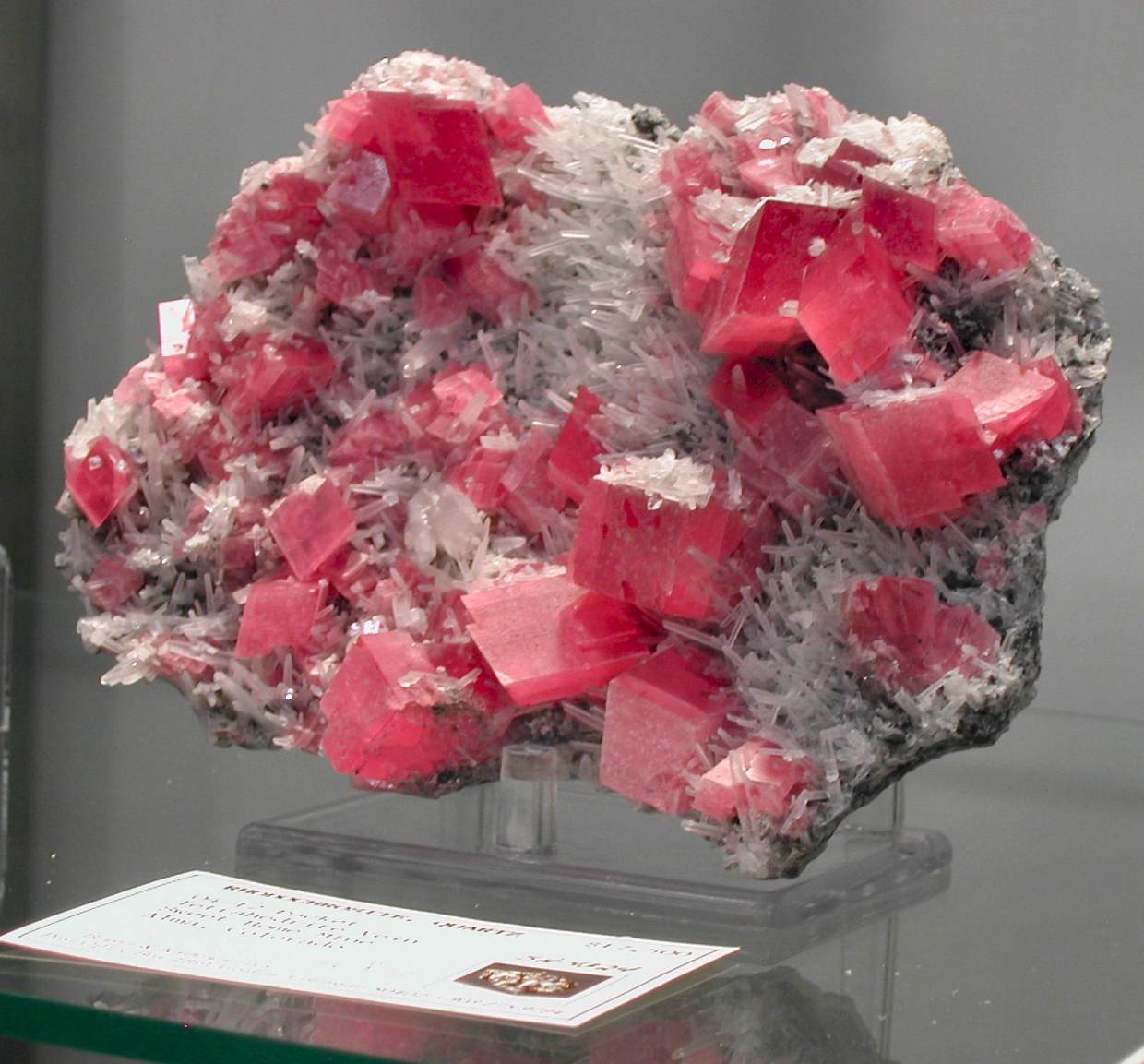 |
A real fine plate of gemmy rhodochrosite crystals on a needle quartz matrix from the world-famous Sweethome Mine, Alma, Colorado. This old silver mine was reopened and actively mined for world-class mineral specimens for about 10 years, starting around 1994. Bryan Lees of Collector's Edge Minerals in Golden, CO was the owner and operator. Specimens from this productive era are in museums and private collections all over the world. The fascinating story of it's history has been well documented in mineral magazines, books, and even on DVD. Regrettably, decreased production and increased mining costs led to it's closure in 2004. |
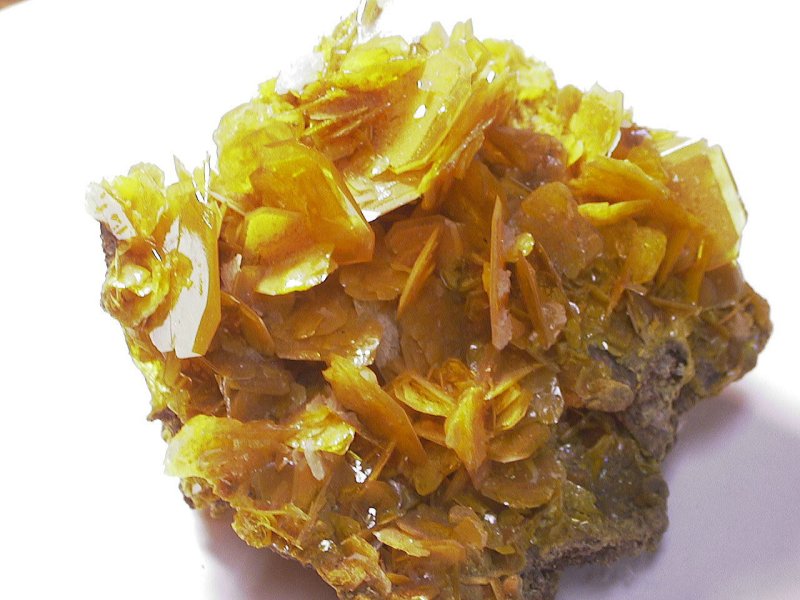 |
A fine golden yellow wulfenite from the San Francisco Mine, Cerro Prieto, Sonora, Mexico. These are very beautiful, but extremely delicate due to the thinness of the bladed wulfenites. These specimens came out around the early 1990's. Wulfenite is a lead-molybdenite mineral and is often found in the mines of Arizona and old Mexico and the desert areas around them. The USA has also produced minor wulfenite from New Mexico and back East at a few isolated mines. Wulfenite is popular with collectors due to it's colors and esthetics in spite of its delicate nature. Spomer collection. |
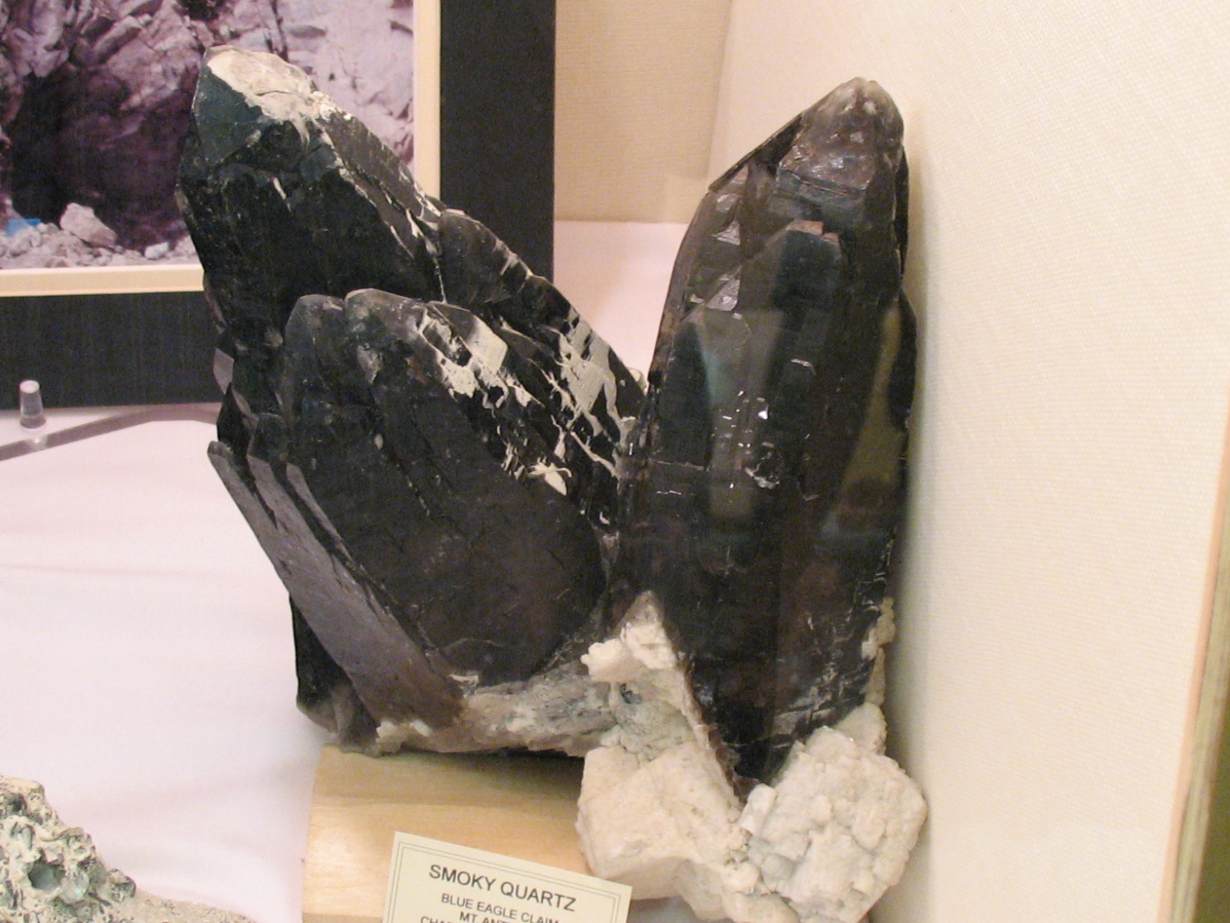 |
Some nice large smokies (~ one foot long) collected by Jeff Self on Mt.Antero a few years ago. |
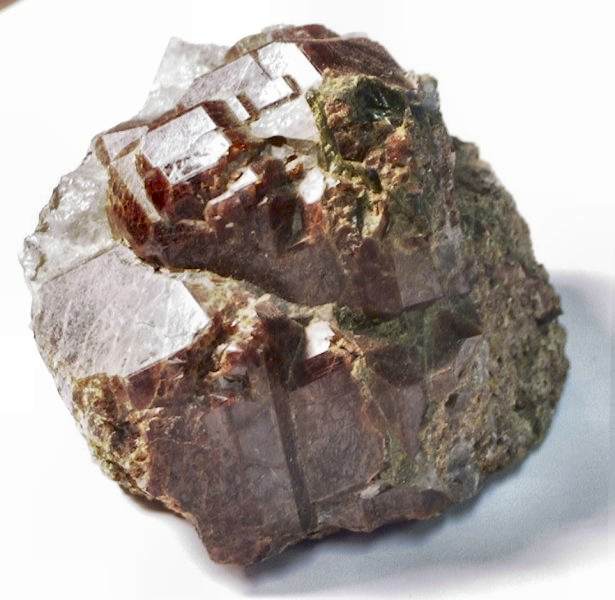 |
A nice large brownish grossular garnet specimen with minor epidote from a locality in Jefferson Country, near Denver, and mentioned in Richard Pearl's old Colorado Gem Trails and Mineral Guide. Many of these localities on the Front Range near urban areas are hunted out or are no longer accessible to the public. This specimen was recovered from a road cut by Howard Bachman (deceased) in the 1970's or early 80's. |
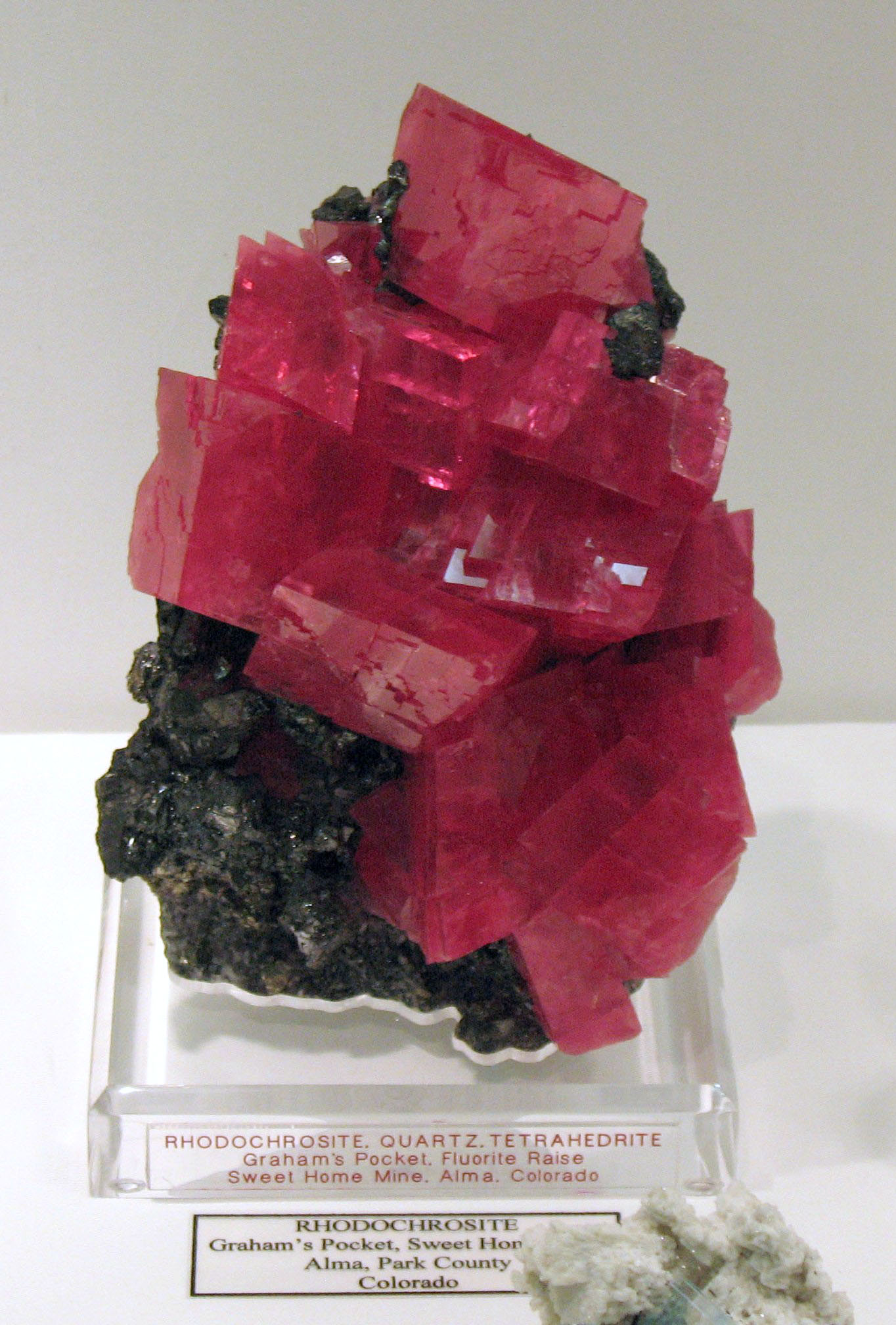 |
Another superb rhodochrosite gem crystal specimen from the Sweethome Mine. |
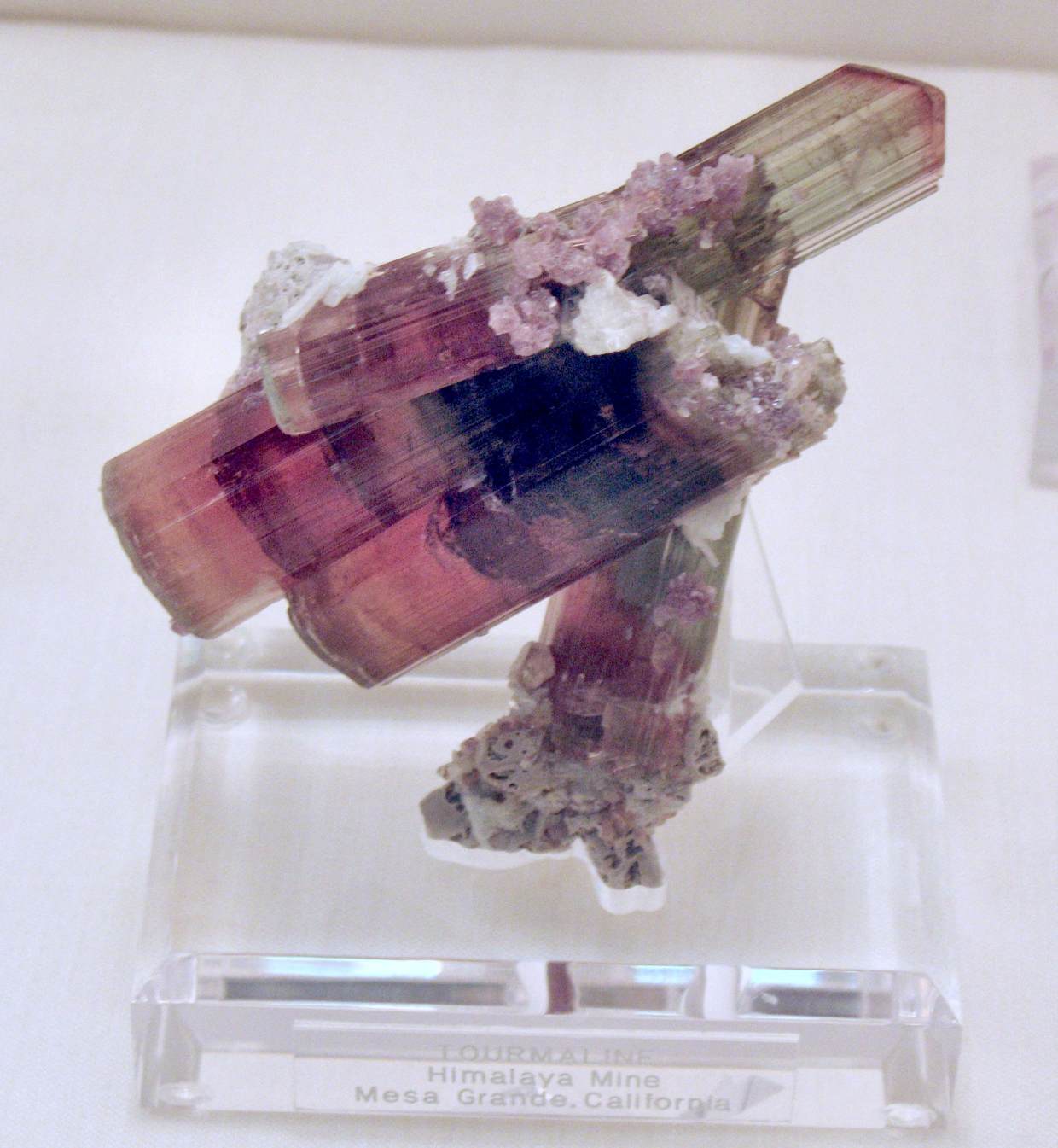 |
A fantastic cluster of multi-color tourmaline (elbaite) crystals from the world-class Himalaya Mine in Mesa Grande, California. This mine has produced more fine specimens than any other tourmaline mine in North America. |
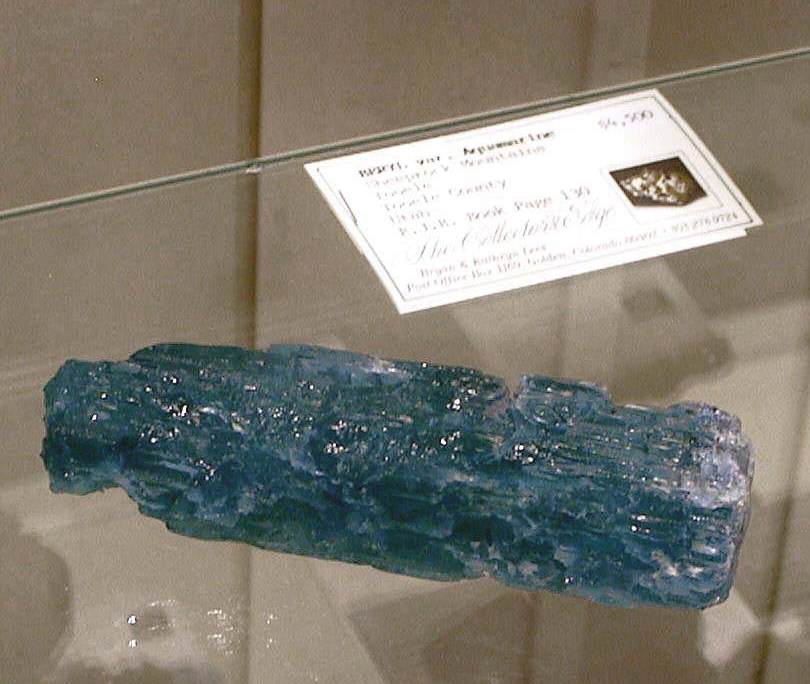 |
Deep blue etched gemmy aquamarine crystal from Utah. These are not real common and seldom on the market. |
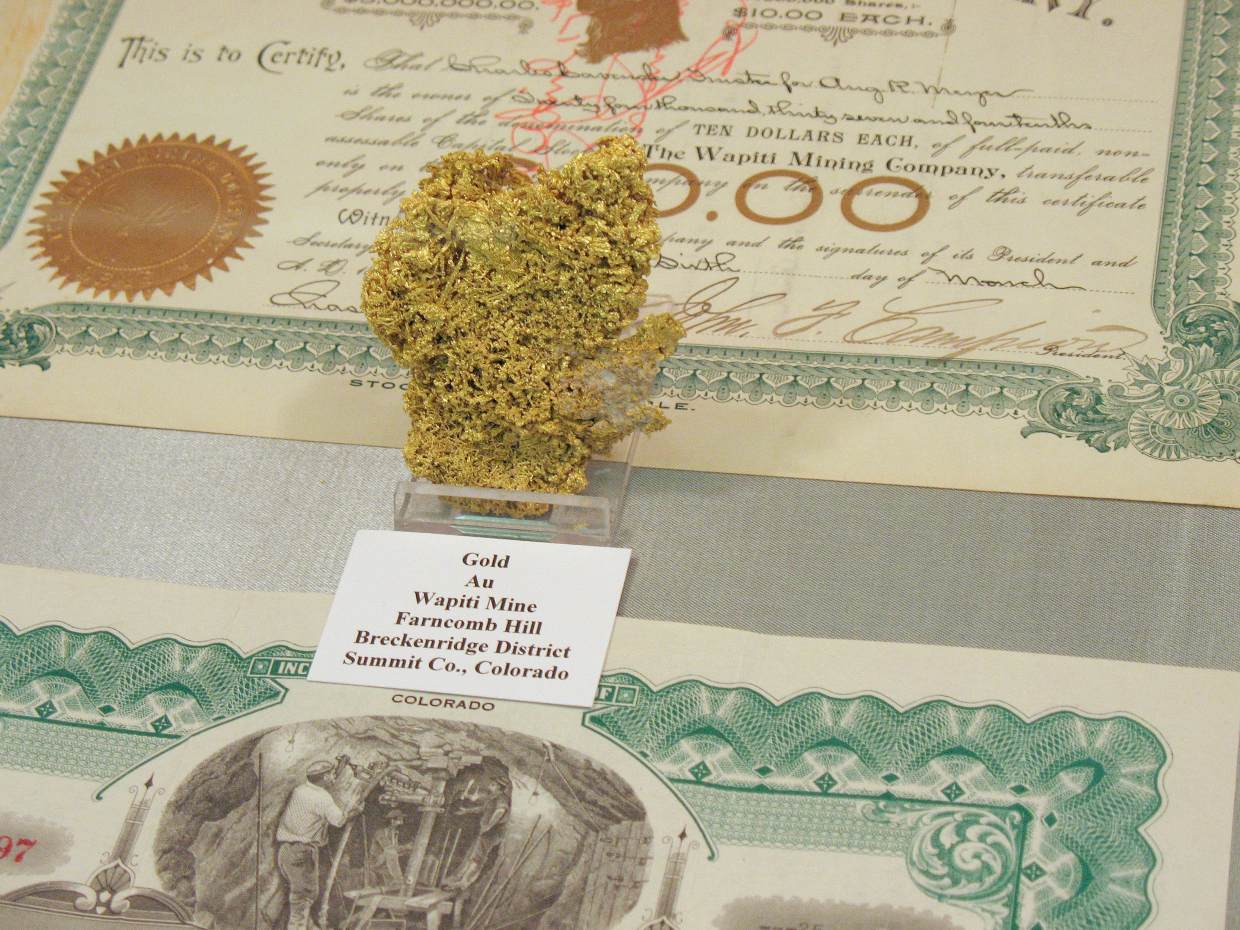 |
Fine crystallized gold specimen from the world famous Farncomb Hill area of Breckenridge, Colorado. |
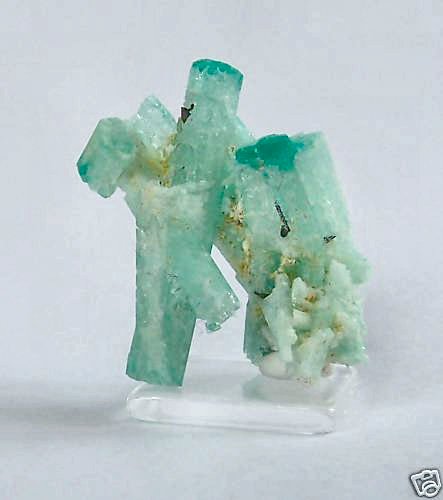 |
A cool cluster of light emerald crystals from Hiddenite, North Carolina. This area has produced the only long-term reliable source for emerald in North America. Still, the quality and quantity are far less than Columbia, Brazil, and several countries in Africa, as well as Pakistan. |
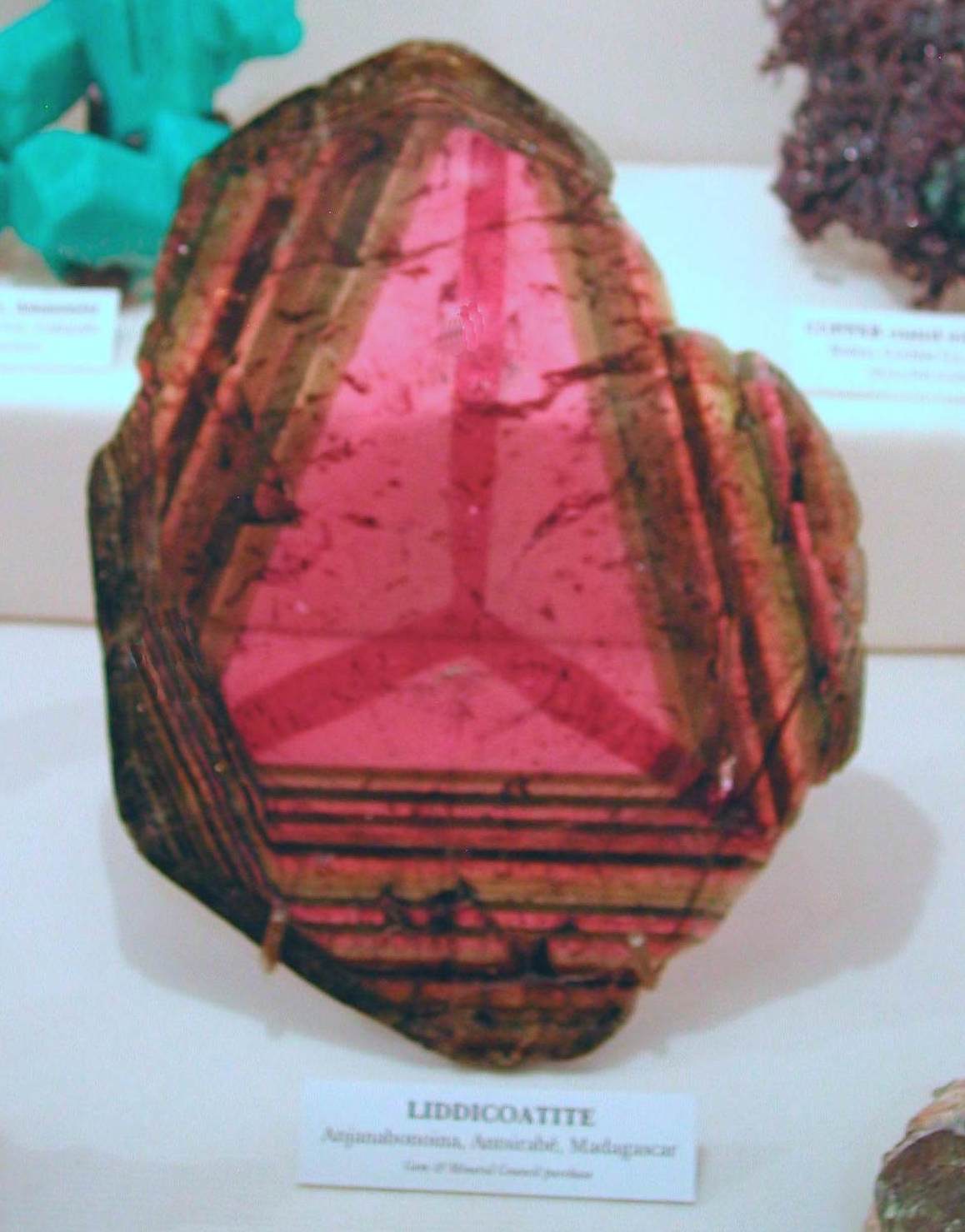 |
A large polished slab of zoned watermelon liddicoatite from Madagascar. Most gem mines that produce gem watermelon tourmalines contain the variety elbaite. Liddicoatite is typically triangularly zoned like this. |
 |
Crocoite, a brilliant orange-red lead chromate mineral, and very rare, except at a particular mine or cluster of mines in Tasmania. The crystals are a bit fragile, just like they look, and must be collected with care, then etched from the matrix with chemicals. |
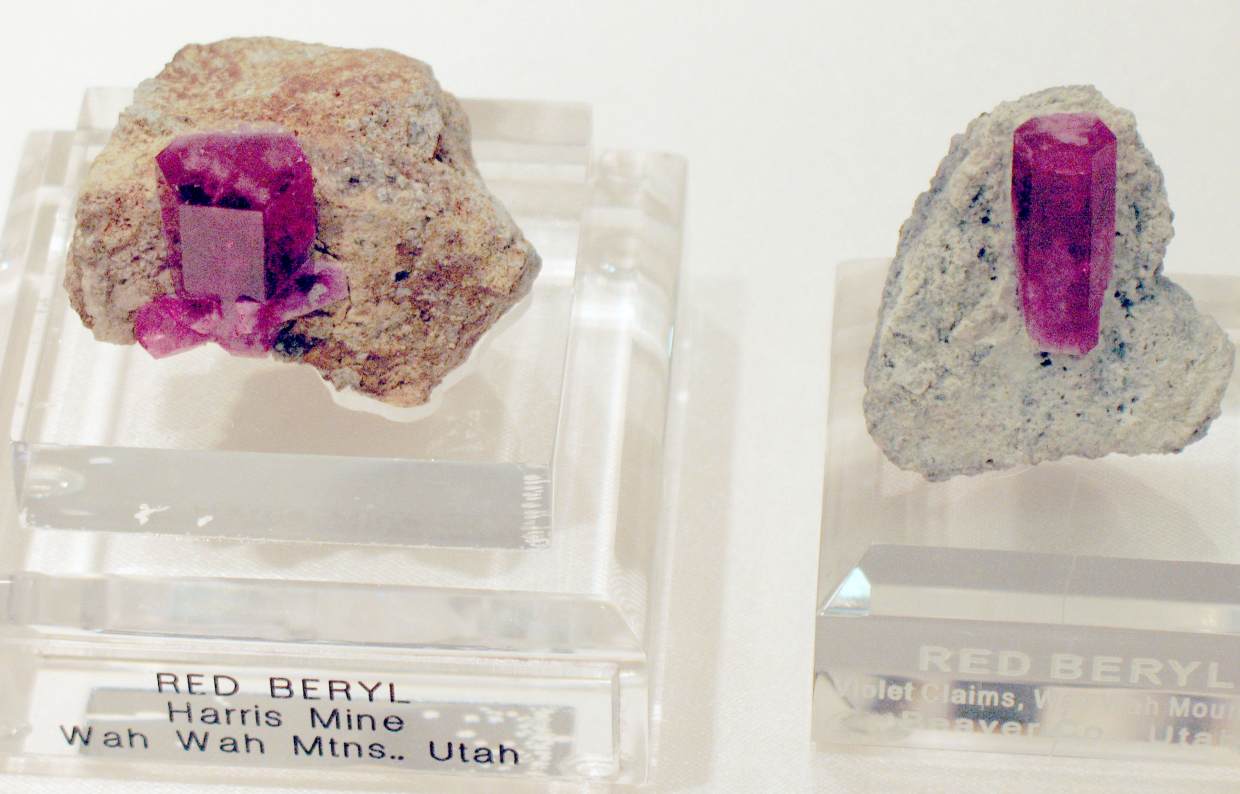 |
Red beryl, or bixbite, one of the rarest gems in the world. Most of the gem material comes from the Violet Claims in the Wah Wah Mts. of western Utah. Several other collecting areas have smaller red beryls, but they tend to be more orangish-red and are seldom gem quality. The crystals formed in a volcanic rhyolite matrix. |
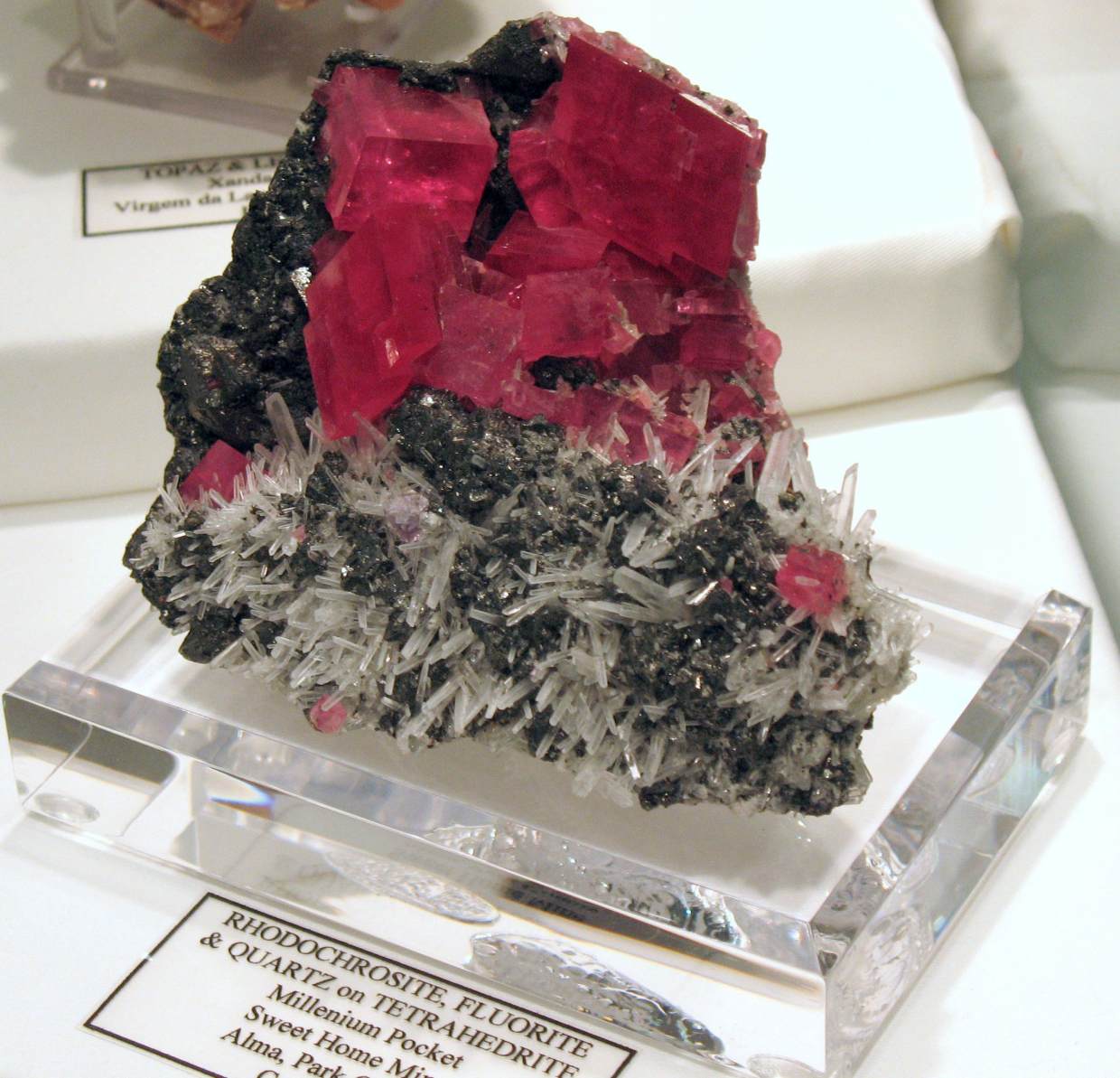 |
Another super rhodochrosite cluster from the Sweethome Mine, Alma, Colorado. |
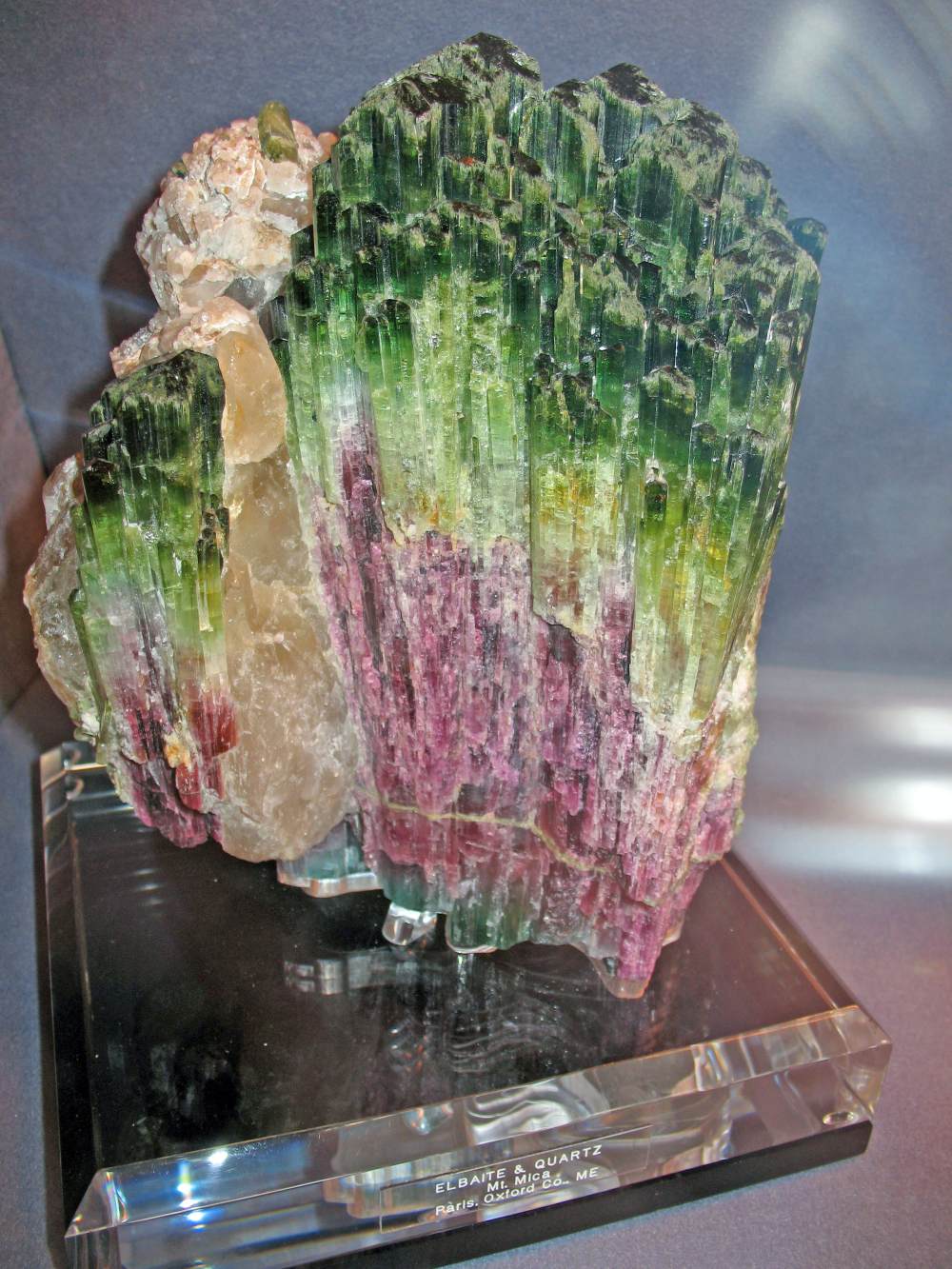 |
This large watermelon tourmaline was mined around 2006 at Mt. Mica, Oxford County, Maine. Mt. Mica is the oldest gem mine in the U.S.A. It was discovered in the early 1800's by the Hamlin brothers, and was developed and operated sporadically since that time. Maine is famous for quality tourmaline, not so much large quantities, but this mine and the Plumbago Gem Pit at Newry have produced the most. Other gems such as morganite, rose quartz crystals, and rarities too numerous to mention occur there as well in small concentration. Collectors can sometimes arrange to glean through the dumps of these mines during summer months, but usually the opportunities are limited. |
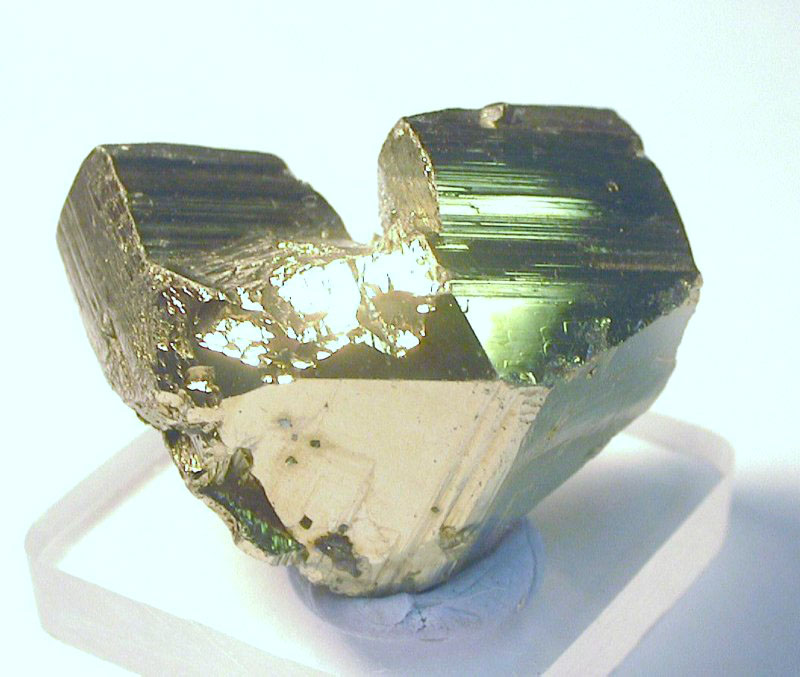 |
Pyrite from the old Gilman Mine, north of Leadville, came out in large quantities while the mine operated. It ceased operations around 1980. Still many old specimens abound in Colorado collections. This specimen shows an unusual habit of some, with two crystals forming into one at one end. Pyrite can form perfect cubes, octahedrons, pyritohedrons (they look kind of like soccer balls), or a complex combination of several. Spomer collection. |
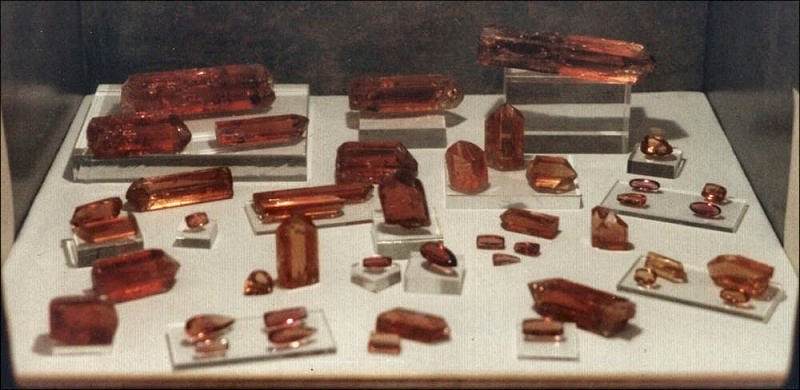 |
The finest display of gem Imperial topaz from Ouro Preto, Minas Gerais, Brazil I have ever seen. This was on display a few years back at Tucson. The golden color is permanent and does not fade. It is presumably caused by iron content. The pinkish color is due to chromium. Imperial topaz can sometimes be "pinked" using heat from a kiln or oven. Flawless, clean crystals such as this are quite rare, and usually get cut into valuable gemstones quickly. Topaz as a gem comes in colorless, blue, champagne, sherry, green, pink, red, and gold. Champagne and sherry topazes are not color stable and will fade in the sun, either quickly or over time. Ouro Preto is almost an exclusive area of origination for the pinkish-gold color-stable variety known as Imperial, or "precious topaz". |
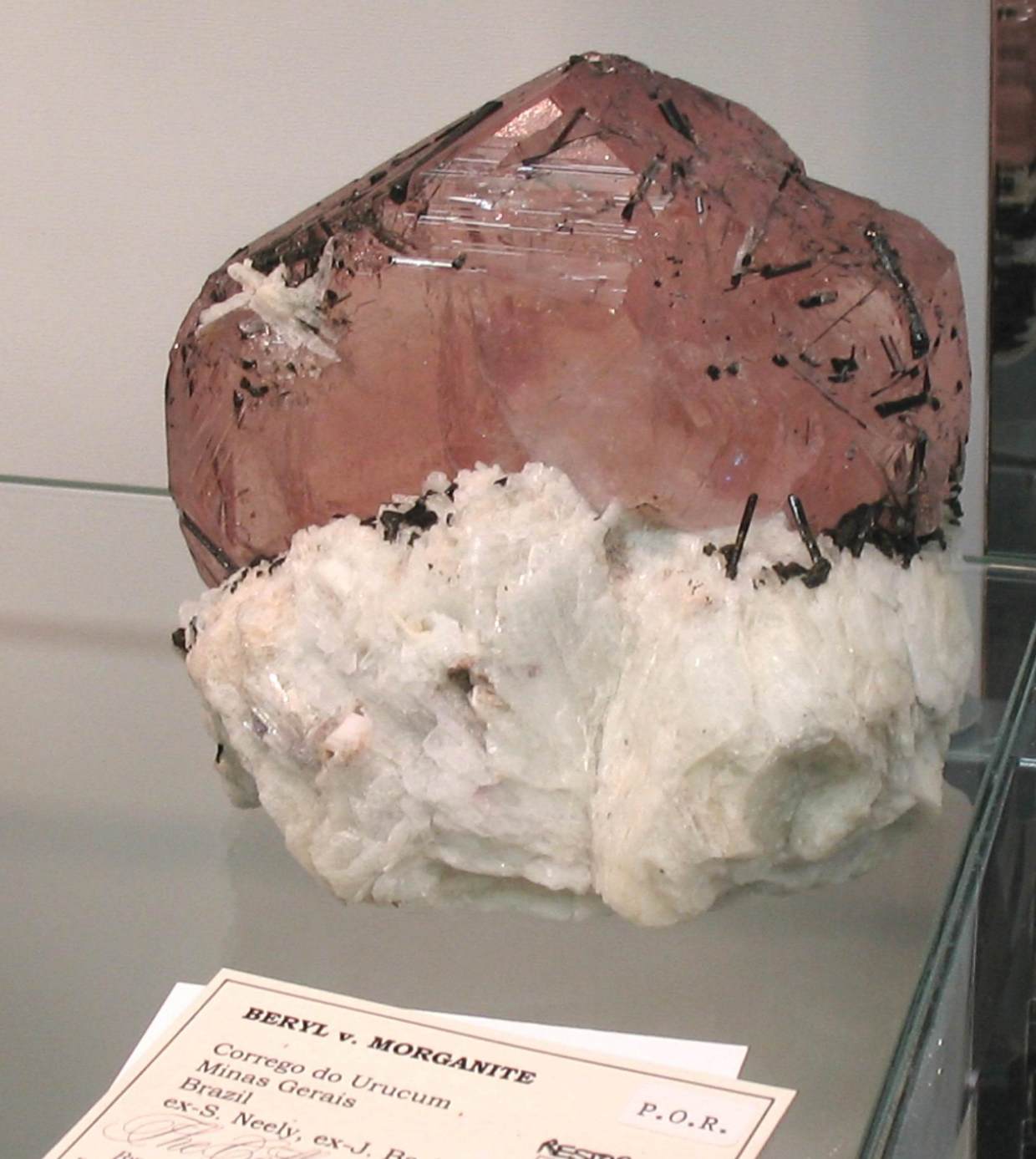 |
Gem quality pink or peach beryl, or morganite, often occurs in granite pegmatites along with tourmalines (there are green tourmalines along the edge of this crystal) and other gems. Brazil is the largest producer, but lately Afghanistan has been finding a large amount, with some also coming from Mozambique. California and Maine have produced minor amounts. The crystals are usually tabular instead of elongated like most beryls (aquamarine, heliodor, emerald, etc.). Some crystals have been recently recovered from several localities that are bi-colored, usually with a peachy morganite core and blue outer layer (aquamarine). The peach color can be driven to pure pink with gentle heat or sometimes even exposure to sunlight over time. |
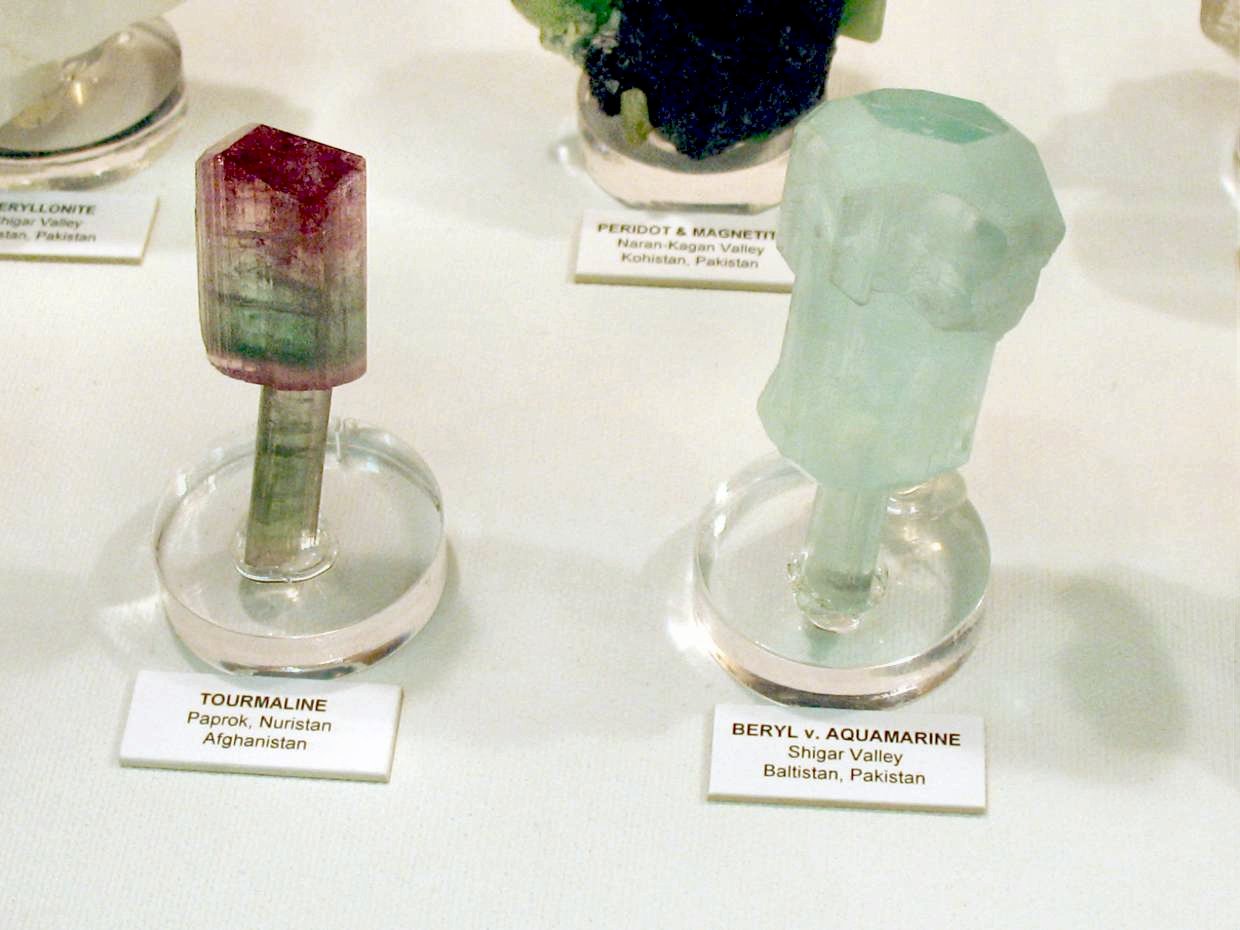 |
Two unusual and interesting sceptered crystals on display at a recent Denver gem show. The crystal on the left is a sceptered watermelon tourmaline, from Afghanistan the one on the right a sceptered aquamarine from Pakistan. |
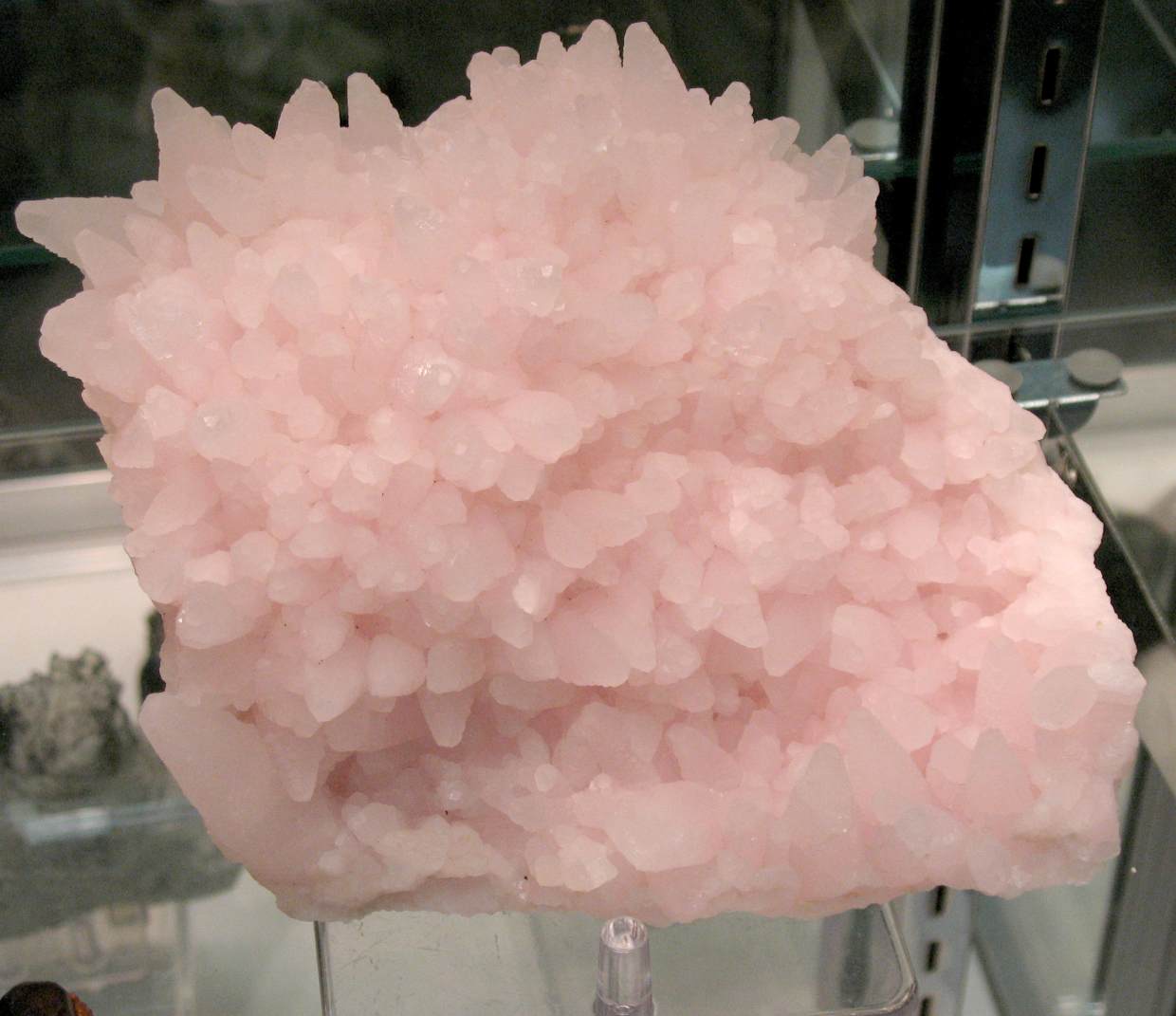 |
Pink manganocalcite forms in pointy crystal clusters such as this. It's composition is part-way between calcite (calcium carbonate) and rhodochrosite (manganese carbonate). Many nice specimens such as this were extracted from the Idarado Mine back when it operated. The Idarado Mine was on Red Mt. Pass between Silverton and Ouray, but tunnels ran for miles underground to as far as Telluride. The Idarado also produced fine white and clear quartz clusters, calcite specimens, sulfide minerals, and of course gold, including fine gold in quartz slabs. Manganocalcite has been more recently mined in Peru. |
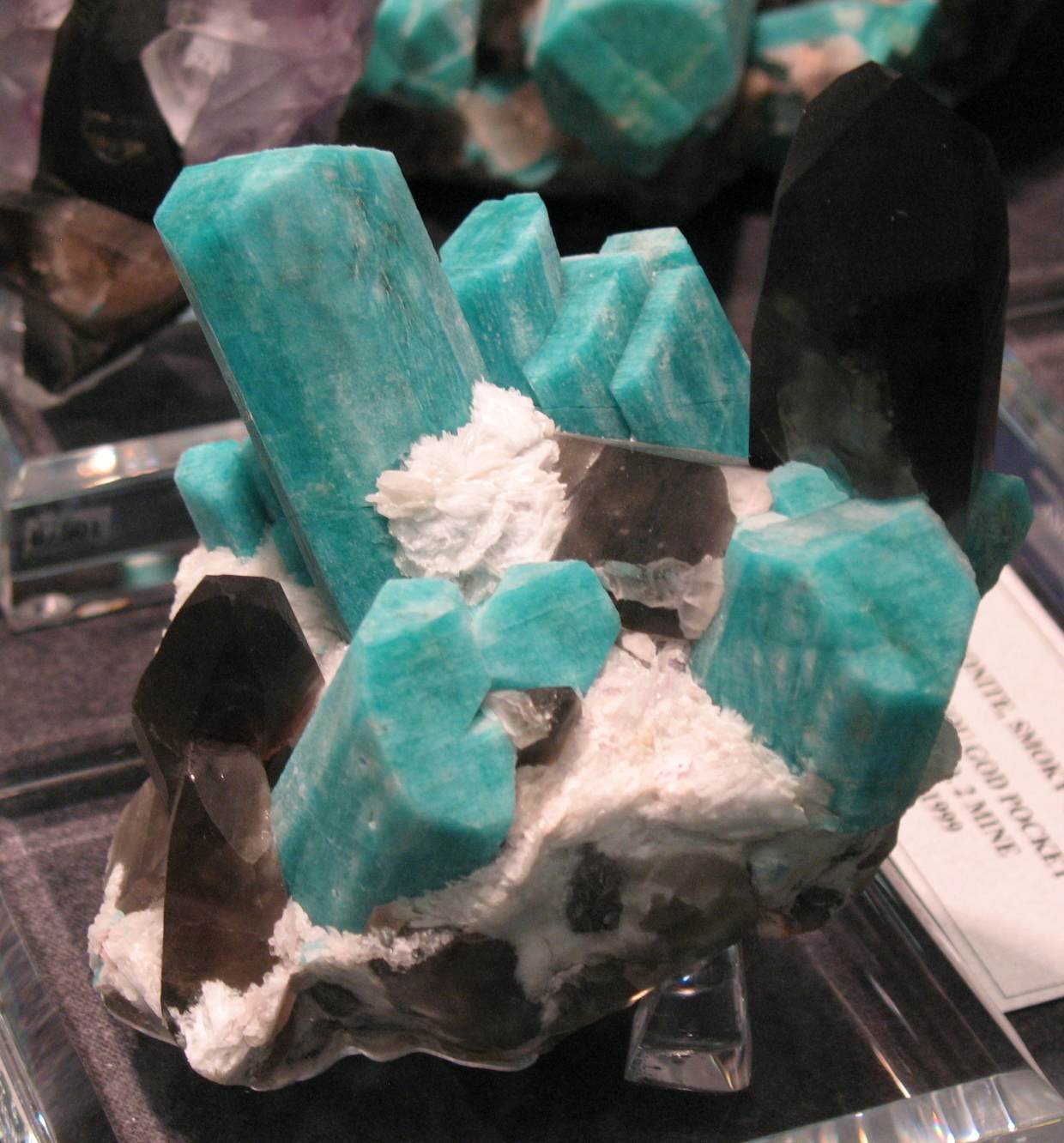 |
Another outstanding amazonite and smoky quartz cluster on cleavelandite, from the Crystal Peak area of Colorado. This area lies mostly north of the villages of Lake George and Florissant along Hwy 24. Much of the productive land is now private housing, while some is on national forest land. And most of the forest land is also under private claim, so access for the average rockhound is fairly limited. |
 |
See more photos on next page: Photo Album Page 3 On the previous page: Photo Album Page 1 |
Come back again as I plan to add more photos as time permits.
All photographs shown here are for your viewing enjoyment only. Copyrights are retained by original photographer or publisher. Please see our Copyright page for more information.
All photos, scans, gamma corrections, and color adjustments by Robert Spomer, unless otherwise noted.